 blog
blog
Best Wedding Entertainment for Shy Guests: 7 Ideas
Table of Contents
- Why Shy Guests Need Different Wedding Entertainment
- Wedding Entertainment Ideas for Introverts
- Wedding Entertainment Without Dancing
- A Wedding Magician for Shy Guests
- Small Wedding Entertainment Ideas
- How to Match Entertainment to Your Wedding Timeline
- Quiet Spaces, Sensory Needs and Inclusive Planning
- Conclusion
- Frequently Asked Questions
Last Updated: October 18, 2026
Why Shy Guests Need Different Wedding Entertainment
Loud music and a packed dance floor suit some guests. For others, they are the worst part of the day.
We have performed at weddings and parties for 18 years. We have seen quiet guests come alive when the format gives them an easy way in.
Below, we break down seven ideas and rate each one for how comfortable it feels to someone who hates being the centre of attention.
Wedding Entertainment Ideas for Introverts
The best wedding entertainment for introverts keeps groups small and gives everyone something to do with their hands. Conversation flows when people are not forced to make eye contact across a silent room.
A common mistake is assuming shy guests want to be left alone. Most want to take part. They just need a role that does not involve a spotlight.
Table Games and Conversation Starters
Table games are the easiest win. Put a small stack of cards, dice games, or a simple quiz sheet on each table. Guests can play with the person next to them without leaving their seat.
Conversation starter cards work well too. Write prompts like "best holiday you have ever taken" or "the song you would pick for the first dance." They give quiet guests a script to follow.
- Setup: low cost, printed at home
- Introvert rating: 9/10
- Best for: mixed tables where guests do not know each other
Pub Quizzes and Guest Quizzes
A pub quiz gives the whole room a shared task. Nobody has to perform. Teams of four to six work best, and you can mix shy guests with louder ones on purpose.
A guest quiz built from facts about the couple adds laughs without pressure. Keep rounds short, around ten minutes each, and never ask individuals to stand up.
- Setup: one host, printed sheets, small prizes
- Introvert rating: 8/10
- Best for: receptions with a seated meal
Wedding Entertainment Without Dancing
You can plan a full reception with no dance floor at all. Wedding entertainment without dancing works especially well for daytime receptions, older guests, and anyone with mobility limits.
The key is to plan two or three activities that run at the same time. Guests pick one, or none. That freedom is what makes it feel relaxed.
| Idea | Introvert Rating | Setup Level | Best Moment |
|---|---|---|---|
| Table games | 9/10 | Low | During drinks |
| Pub quiz | 8/10 | Medium | After the meal |
| Lawn games | 8/10 | Medium | Afternoon |
| Close-up magic | 9/10 | Low | Drinks reception |
| Photo booth | 7/10 | Medium | Evening |
| Live acoustic music | 8/10 | Medium | Throughout |
Lawn Games and Outdoor Activities
Lawn games give shy guests something to do with their bodies. That sounds small, but it matters. Standing, throwing, and aiming removes the awkwardness of standing still with a drink.
Set up giant Jenga, ring toss, croquet, and giant Connect Four at the edge of the venue. Spread them out so nobody feels watched. Add a bench nearby for guests who prefer to spectate.
- Setup: hire or borrow, needs flat ground
- Introvert rating: 8/10
- Best for: outdoor weddings and long summer afternoons
A Wedding Magician for Shy Guests
Close-up magic is the strongest option for quiet guests.
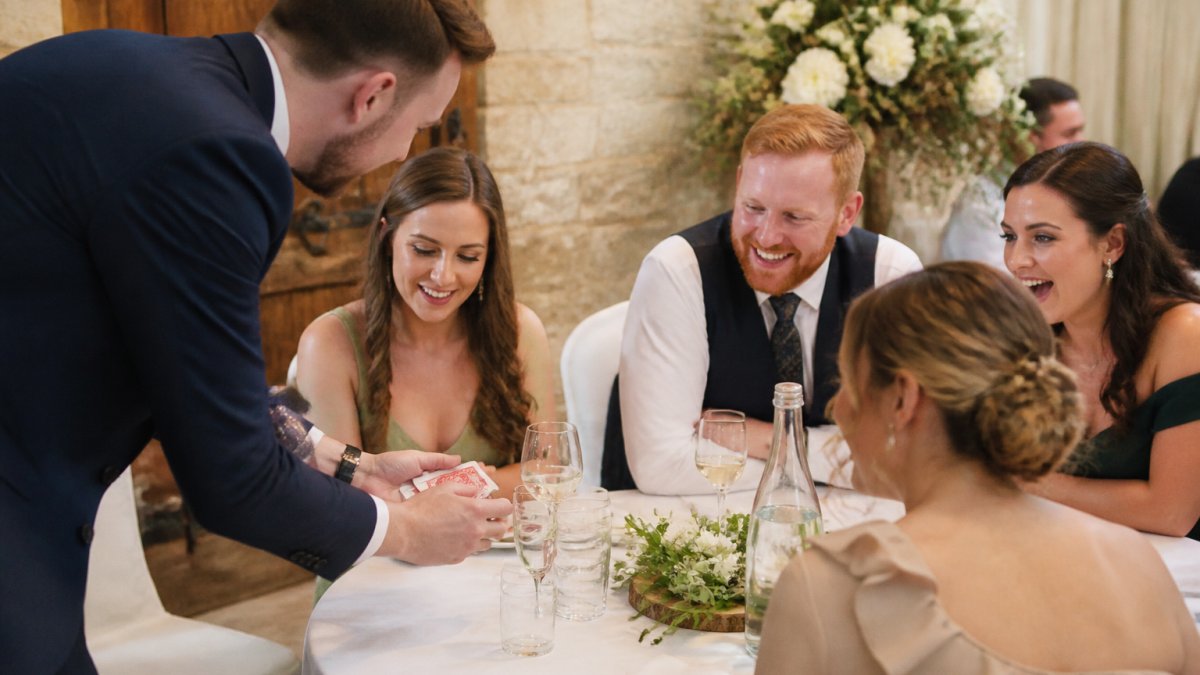
The format suits introverts for a simple reason. Magic gives the group a shared focus.
I have performed this way for 18 years across weddings, birthday parties, and corporate events.
- Setup: none, works in any room
- Introvert rating: 9/10
- Best for: drinks receptions and gaps in the schedule
If you are worried about whether the humour will fit your crowd, ask to see recent references and video footage before you book.
Small Wedding Entertainment Ideas
Small wedding entertainment ideas should feel like a gathering, not a show. With 30 to 60 guests, everyone notices who is not joining in. That is exactly why the format has to be gentle, and why the numbers matter more than the ideas.
At that size, one anchor activity plus one passive option is usually enough. Two simultaneous activities is the practical ceiling: with 40 guests, splitting the room into two groups of 20 still leaves each group large enough to feel like a crowd to a shy guest.
The anchor-plus-passive formula
Pick one activity that gives people a shared task and one that lets them watch. The anchor carries the room; the passive option gives shy guests a legitimate place to be without performing.
- Anchor: a roaming close-up magician, a hosted pub quiz, or a shared table game. One only.
- Passive: a drinks station, a dessert table, a photo display, or a quiet corner with seating. These need no host and no announcement.
- Capacity check: a roaming magician can work a room of 40 in roughly 60 to 90 minutes at three to five minutes per table group. A quiz for 40 needs about 45 minutes including marking. Plan the anchor to fill the drinks hour, not the whole evening.
What to skip at small weddings
- A DJ plus a band plus a dance floor. Three focal points in a small room create pressure to be seen at one of them.
- Full-room icebreakers. "Everyone stand up and find someone wearing the same colour" is the single most reliable way to lose a shy guest to the car park.
- Long speeches before the meal. They delay the point at which guests have something to do with their hands.
Invite participation without putting guests on the spot
The host or MC sets the tone in one sentence. A workable script: "There is a quiz on each table after the meal, join in if you fancy it, and there is no need to stand up or read anything out." That single line gives permission to opt out, which is what shy guests are listening for.
For the magician or roaming performer, the equivalent cue is: "I will come round the tables during drinks, no volunteers needed, just watch if you like."
Small rooms also make it easier to include guests with different needs. Seating can be arranged so people can move around without squeezing past others, and a 40-guest room usually has space for one genuinely quiet corner rather than a corridor.
How to Match Entertainment to Your Wedding Timeline
Timing decides whether an activity lands or falls flat. Put the wrong idea in the wrong slot and even a great performer will struggle.
Here is how we would plan it:
| Timeline Slot | Best Entertainment | Why It Works |
|---|---|---|
| Arrival drinks | Close-up magic, lawn games | Guests are standing and arriving |
| Seated meal | Table games, conversation cards | Keeps tables talking |
| Post-meal gap | Pub quiz, guest quiz | Stops the lull before evening |
| Early evening | Photo booth, acoustic music | Low commitment, easy to join |
| Late evening | Dance floor, group dancing | Suits the guests who stay on |
The gap after the meal is the one most couples get wrong. Guests are fed, the room is being reset, and shy guests often slip away. Fill that slot first.
Quiet Spaces, Sensory Needs and Inclusive Planning
Every wedding with shy guests needs one quiet room. Not a corridor. A real room with seating, softer lighting, and no music. Guests who feel overwhelmed will use it, then come back, but only if it is genuinely quiet and genuinely easy to find.
This is the area most wedding entertainment guides skip entirely. The practical detail below is what turns "we will have a quiet corner" into a plan that works.
What a usable quiet space needs
- A door that closes. An open alcove off the bar is not a quiet space; it is a viewing gallery.
- Distance from the speakers. Aim for a room that is not sharing a wall with the band or DJ. If it does, ask the venue whether the sound can be isolated.
- Seating for at least four people, including one seat with arms that is easy to rise from.
Noise, lighting and sensory load
Loud bass, flashing lights and sudden noise are uncomfortable for some guests, and not only those with a diagnosed condition. A few practical adjustments cover most of it:
- Keep background music low during speeches and conversation points. If guests who lip-read or use hearing aids cannot follow the room, they disengage.
- Ask about strobe and moving lights before the evening party. Many venues can run a static lighting state instead.
- Warn, don't surprise. If there is a sparkler exit, confetti cannon or loud first dance, tell guests in advance on the order of the day. Surprise noise is the main trigger; expected noise is manageable.
Adapting activities for mobility, hearing, vision and language needs
Inclusive planning is not a separate activity list, it is a set of adjustments to the ones you have already chosen.
- Mobility: check that lawn games can be played from a seated position or with a shorter throw, and that outdoor paths are firm underfoot. Giant Jenga and ring toss adapt easily; croquet less so.
- Hearing: table games and quizzes work well because they are visual and written. Avoid activities that depend on hearing a host over music.
- Vision: use large-print quiz sheets and high-contrast cards. A roaming magician should describe what is happening as well as show it.
The opt-out test
Before you sign off the plan, walk the day as a guest who knows nobody. Can they arrive, find a drink, watch one activity without being asked to join, use the quiet room without explanation, and leave without being noticed? If any step fails, that is the fix to make first.
Conclusion
Planning entertainment around shy guests takes more thought than booking a band and hoping. It means offering choice, keeping groups small, and filling the awkward gaps in the day.
If you want one option that works for every age and personality, close-up magic is hard to beat. Paul Newman Magician brings 18 years of experience to weddings, birthday parties, and corporate events, with no stage, no spotlight, and no pressure on your guests.
Frequently Asked Questions
How can you keep shy guests entertained at a wedding?
Offer low-pressure activities that let shy guests choose whether to join in. Table games, conversation starters and a pub quiz give people something to do without being the centre of attention. A close-up magician who moves between tables also works well because guests can watch and react without leaving their seat. Avoid anything that forces audience participation, and make sure there are quiet corners where guests can take a break from the noise.
What wedding entertainment works well for introverts?
Introverts tend to prefer activities with a clear role or a small group. Wedding entertainment ideas for introverts include lawn games like giant Jenga or croquet, a dessert bar or cocktail hour where people can chat one-to-one, and table games that spark conversation. A wedding magician for shy guests is another strong option because close-up magic is opt-in and happens in small groups. The key is giving people something to focus on so they are not left making small talk.
How can you make a wedding reception enjoyable without dancing?
Plan entertainment that gives guests something to do besides the dance floor. Wedding entertainment without dancing can include a live acoustic set, a caricature artist, a pub quiz, lawn games or food and drink stations. These options suit guests who do not enjoy dancing and keep the reception moving through the cocktail hour and gaps between courses. Mix two or three low-key options so guests can drift between them at their own pace.
How do you make wedding entertainment inclusive for different personalities?
Offer a mix of opt-in activities and quiet spaces. Include low-pressure options such as table games and conversation starters, plus louder options like live music and group dancing for guests who enjoy them. Make sure participation is never forced, and check that activities work for varied mobility and communication needs. A small wedding entertainment ideas list with two or three calm choices and one or two lively ones usually covers the widest range of guests.
Shy guests remember how a wedding felt, not how loud it was. Build in low-pressure fun, protect a quiet corner, and time your activities around the lulls. Get started with Paul Newman Magician and give every guest a way to join in on their own terms.