 blog
blog
Corporate Event Icebreaker Ideas for Staff
Table of Contents
- Why Corporate Event Icebreakers Matter
- 5-Minute Icebreakers for Meetings That Work
- 10-Minute Icebreaker Games for Groups
- Icebreaker Questions for Work Conversations
- Team-Building Activities for Work Events
- Making Icebreakers Inclusive and Cringe-Free
- How Live Entertainment Elevates Your Corporate Event
- Conclusion
- Frequently Asked Questions
Last Updated: October 10, 2026
Why Corporate Event Icebreakers Matter
A corporate event icebreaker is a structured activity designed to help staff members relax, connect, and start conversations in group settings. The opening moments of an event shape the entire experience, whether people bond or sit in silence often depends on what happens in those first ten minutes.
Without a deliberate icebreaker, attendees cluster in small groups or check their phones (Breaking the Ice: A Pre-intervention Strategy to Engage Research Participants). The best corporate event icebreaker ideas for staff accomplish three things: they lower social anxiety, create legitimate reasons for people to interact, and generate genuine laughter.
5-Minute Icebreakers for Meetings That Work
Five-minute icebreakers fit perfectly into tight schedules and require minimal setup. They work best when you need something quick to warm up a group before diving into the main agenda.
Two Truths and a Lie
Ask each person to share three statements about themselves, two true, one false. The group votes on which is the lie. It requires zero preparation and generates genuine curiosity.
This corporate event icebreaker reveals surprising things about colleagues, the quiet accountant climbed Kilimanjaro, the manager speaks three languages. It takes roughly two minutes per person in a group of ten.
How to run it:
- Have each person prepare their three statements in advance (or give them 30 seconds to think)
- Go around the room; each person reads their statements aloud
- The group votes on which is false (by show of hands, or call it out)
- Reveal the answer and move to the next person
Materials needed: None
Group size: 5-20 people (works best in smaller groups; larger groups risk losing attention)
Timing: 2 minutes per person; 20 minutes for a group of ten
Accessibility notes: Works well for neurodivergent staff and those with social anxiety because people control what they share. Allow extra thinking time for non-native English speakers or permit written statements.
Question Ball Toss
This icebreaker game requires one soft ball and a marker. Write 8-12 questions on the ball surface: "What's your hidden talent?", "What's your dream holiday destination?", "What skill do you want to learn this year?"
One person tosses the ball to another. Wherever their thumb lands, they answer that question. It combines physical movement with genuine conversation starters.
Materials needed:
- One soft foam or beach ball (approximately 20-30 cm diameter)
- Permanent marker
- 8-12 interesting questions written on the ball (use clear, large lettering)
Group size: 8-25 people
Timing: 5-8 minutes
Facilitation tips: Demonstrate the toss to show how to find a question with their thumb. Keep the energy light and fast-paced.
Accessibility notes: Offer alternatives for mobility or visual impairments: pass the ball instead of tossing, or read questions aloud without the physical element.
Speed Networking Pairs
Pair people randomly and give them three minutes to chat. When time's up, rotate partners. Run 3-4 rounds so everyone meets 3-4 new people.
This corporate event icebreaker works because the time limit removes pressure, people commit fully knowing the conversation will end.
Materials needed:
- Timer (use your phone or a visible countdown clock)
- Optional: conversation prompt cards (one prompt per round)
Group size: 6-50 people (works best with even numbers; if odd, the facilitator pairs with someone)
Timing: 3 minutes per round; 12-15 minutes total for 3-4 rounds
Setup: Arrange the room so pairs can stand or sit facing each other without obstruction. Brief people on the format before starting.
Facilitation tips: Provide a conversation starter for each round to prevent awkward silences.
Accessibility notes: For seated participants or those with hearing difficulties, use a visual signal instead of a bell. Allow people to opt out of physical proximity if uncomfortable.
10-Minute Icebreaker Games for Groups
With more time, run activities that build deeper connection. These work well for workshops, team-building events, or conference opening sessions.
Bingo with Personal Interests
Create a bingo card with traits or experiences: "Has travelled to Asia", "Speaks more than one language", "Has worked here over five years", "Loves cooking", "Plays an instrument". People circulate, finding someone who matches each square, and have that person sign the card.
First person to get five in a row wins a small prize. This icebreaker game combines movement, conversation, and a light competitive element.
Setup time: 5 minutes Activity duration: 8-10 minutes Best for: Groups of 15-40 people
Common Ground Circle
Stand everyone in a circle. Start with a broad statement: "Everyone who has worked here over two years, step forward." Continue with increasingly specific prompts until one or two people remain.
This icebreaker reveals unexpected connections and generates natural conversation starters without forcing anyone to perform.
Name That Talent
Each person says their name and one hidden talent. The next person repeats the previous person's name and talent, then adds their own. Continue around the circle, with each person repeating everyone before them.
This icebreaker game is playful, creates natural laughter, ensures people learn each other's names, and reveals interesting things about colleagues.
Activity duration: 10-15 minutes (depending on group size) Best for: Groups up to 25 people
Icebreaker Questions for Work Conversations
Sometimes the best corporate event icebreaker is simply a well-chosen question matched to your event type, group dynamic, and desired outcome.
Questions by Event Type and Desired Outcome
For networking events and first meetings (low-stakes, discovery-focused):
- What's one skill you'd like to learn this year?
- What's your go-to coffee order or drink?
- What's the best advice you've ever received?
- If you could have dinner with anyone, who would it be?
- What's a hobby you've picked up recently?
- What's the most interesting project you've worked on?
For team meetings and internal events (building connection with colleagues you already know):
- What's your favourite thing about working here?
- What's a win you've had recently, professional or personal?
- What's one thing you'd change about how we work together?
- What's a skill a colleague has that you admire?
- What's something you learned this week?
For large all-hands or company-wide events (inclusive, energizing, low-pressure):
- What's your hidden talent?
- What's something most people don't know about you?
- What's your favourite thing about our company culture?
- What's a goal you're excited about this year?
- What's the best piece of feedback you've ever received?
For workshops or problem-solving sessions (outcome-focused, collaborative):
- What's one challenge you're facing right now?
- What's a solution you've seen work elsewhere?
- What's one thing you'd like to learn from this group?
- What's your biggest priority this quarter?
- What's one thing you'd do differently if you had more time?
Questions to Avoid
Avoid questions that feel too personal, too generic, or that assume shared context. Avoid questions that invite complaints without a constructive frame.
How to Use Questions Effectively
For hybrid or virtual events: Use breakout rooms to ask questions in small groups (3-4 people), then reconvene to share. This works better than asking questions in a large Zoom call, where only a few people will speak.
Team-Building Activities for Work Events
Team-building activities differ from icebreakers in that they're designed to build collaboration and trust, not just initial connection. Many team-building exercises work brilliantly as icebreakers too, especially for corporate events where staff need to work together.
Effective team-building activities:
- Collaborative drawing: Teams get 10 minutes to draw something together (a dragon, a bridge, their company's future) without talking. Then they explain their creation. It builds cooperation and reveals different communication styles.
- Problem-solving challenges: Small groups solve a puzzle or logic problem together. It creates natural teamwork and gives quieter people a chance to contribute.
- Shared wins discussion: Ask people to share a recent win, professional or personal. It shifts the energy to celebration and helps people see colleagues as whole people, not just job titles.
- Two Truths and a Lie (team version): Teams collaborate to create three statements about their group, then other teams guess which is false.
These activities work because they require collaboration and generate genuine moments of connection. Unlike pure icebreakers, they also create shared memories, something people reference later.
Making Icebreakers Inclusive and Cringe-Free
The biggest mistake teams make is running an icebreaker that feels forced or puts introverted staff on the spot. A good corporate event icebreaker idea respects different personality types and comfort levels.
Accessibility considerations:
- Avoid activities that require physical movement if some staff have mobility challenges
- Don't force people to share personal information they're uncomfortable with
- Offer opt-out choices without shame ("You can observe this round if you prefer")
- Be mindful of cultural differences in what feels appropriate to share
- Avoid competitive elements that make people feel like they're "losing"
The best icebreakers feel optional, not mandatory. People should feel they can participate fully or partially, depending on their comfort level. Activities that feel like games rather than "trust falls" tend to work better.
How Live Entertainment Elevates Your Corporate Event
Live entertainment transforms a standard corporate event into something memorable. Rather than relying solely on icebreaker games, consider bringing in a professional performer who can engage your entire group.
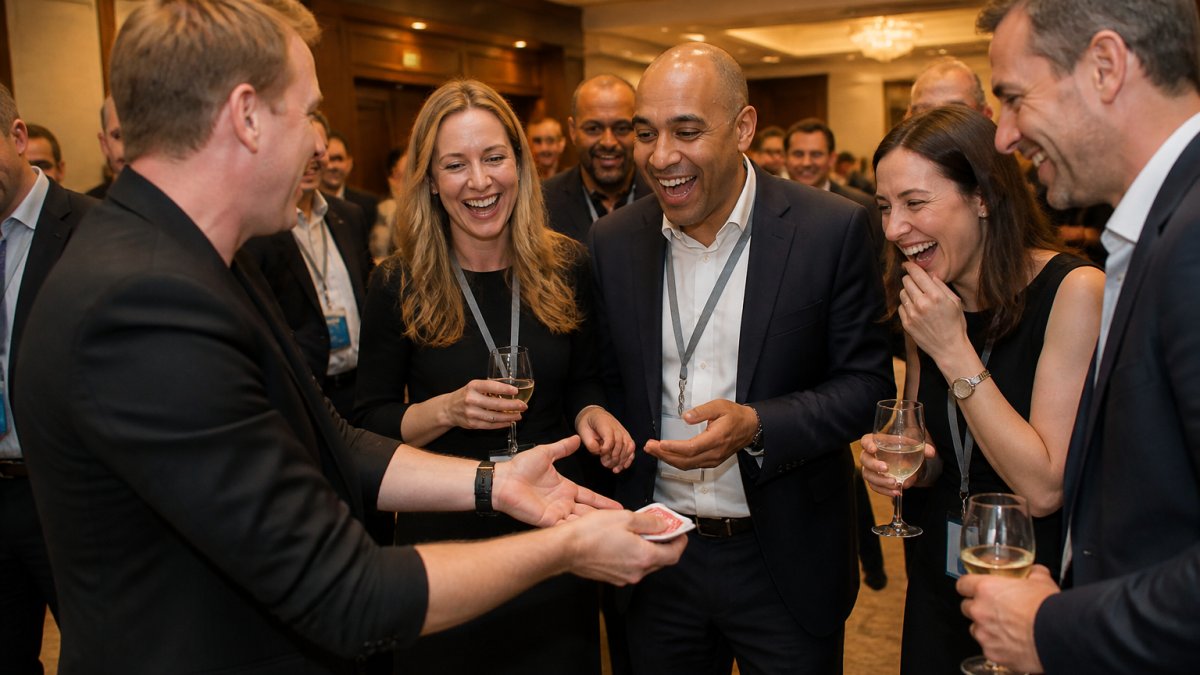
A skilled entertainer creates moments of genuine surprise and shared enjoyment. Close-up magic, for example, works brilliantly as a corporate event icebreaker because it gives people something to talk about.
Paul Newman Magician brings 18 years of experience performing at corporate events across the UK. Rather than running icebreaker games that feel obligatory, entertainment creates natural connection points. Staff members bond over the experience itself.
Live entertainment works particularly well because:
- It breaks the ice without requiring participation from shy staff
- It creates a shared experience everyone can reference
- It demonstrates that the company invested in making the event special
- It provides natural pauses where people can chat and connect
For corporate events, Christmas parties, or milestone celebrations, entertainment often generates better engagement than structured icebreaker games alone.
Conclusion
The right corporate event icebreaker sets the tone for everything that follows. Whether you choose a structured game like Two Truths and a Lie, a movement-based activity like Speed Networking Pairs, or live entertainment that creates shared moments of joy, the goal is the same: help your staff relax, connect, and enjoy each other's company.
For corporate events where you want to guarantee engagement and professional-quality entertainment, Paul Newman Magician delivers close-up magic and interactive performance tailored to your group size and event schedule. With nearly two decades of experience performing at corporate functions across the UK, get in touch to discuss how live entertainment can elevate your next corporate event, contact Paul Newman Magician on 07984620403 or paulnewmancard@hotmail.co.uk.
Frequently Asked Questions
What are some good icebreakers for a corporate event?
Effective corporate event icebreaker ideas include Two Truths and a Lie, Question Ball Toss, speed networking pairs, and Bingo with personal interests. Choose activities based on your group size and available time. For 80 staff members, larger-scale activities like Bingo or Common Ground Circle work better than intimate pair-based games. Aim for low-pressure activities that encourage conversation without forcing participation.
How do you choose an icebreaker for a mixed group of staff?
Consider group size, age range, comfort level, and available time. For mixed-age teams, avoid activities requiring physical movement or personal disclosure that might embarrass older or more reserved staff. Work-related questions and conversation starters feel more natural than personal ones. Test whether the activity works for both shy and outgoing personalities. Hybrid events need digital-friendly options like chat-based questions or breakout room activities.
Can a magician help break the ice at a corporate event?
Yes. Close-up magic works exceptionally well for corporate icebreakers because it draws people together naturally, creates shared moments of wonder, and gives shy staff a low-pressure reason to approach the performer. Unlike forced group activities, a magician can adapt to your event schedule, working during cocktail hour, dinner service, or between formal sessions.
How can you make a work icebreaker feel less awkward?
Keep icebreakers brief (5-10 minutes), voluntary rather than mandatory, and work-focused rather than deeply personal. Avoid competitive games that create winners and losers. Use facilitator instructions that are clear and light-hearted. Pair structured activities with unstructured mingling time. Live entertainment like magic can give staff something engaging to watch and discuss together.